Let’s talk about brushing your body. Not your hair, not your teeth: the whole rest of you. Dry brushing is one of the oldest, cheapest ways to exfoliate, and a few minutes with a natural-bristle brush before your shower leaves skin feeling softer. The catch is that it all depends on your hand: how hard you press, what you cover, and whether you can reach the middle of your own back.
So here is a routine that works, an honest look at what dry brushing can and cannot do, and how BUFF PRO compares if you would rather let the motion do the work. Plenty of people keep both.
The basics
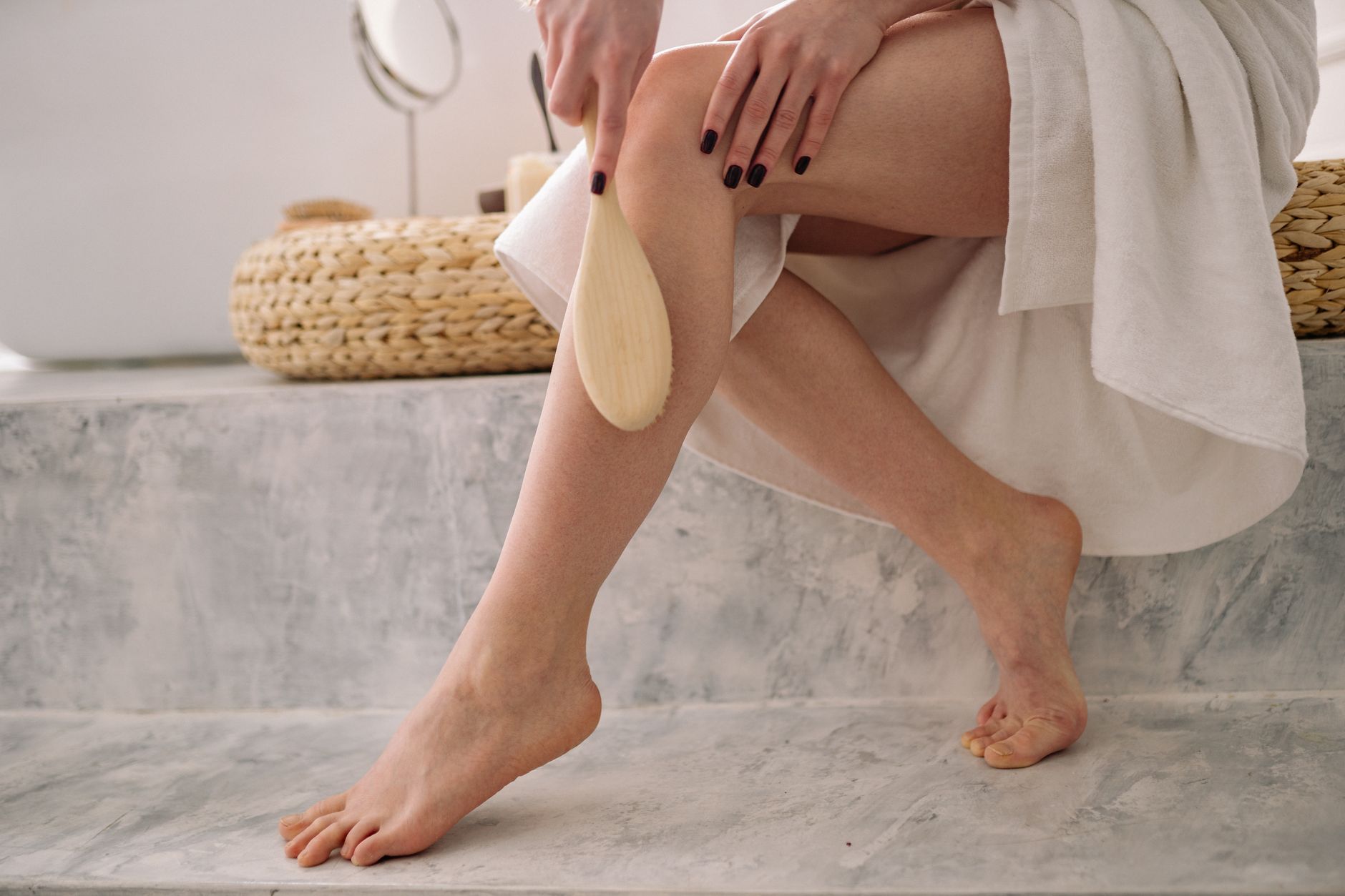
Dry brushing means sweeping a firm, natural-bristle brush over dry skin, usually right before a shower. The bristles lift the loosest dead cells from the surface, and the shower washes them away. That is mechanical exfoliation, the same family as scrubs, gloves and washcloths.
The American Academy of Dermatology describes mechanical exfoliation as using a tool such as a brush, pad or sponge to physically remove dead skin cells, and it suggests matching your method to your skin type (American Academy of Dermatology, How to safely exfoliate at home).
A routine, step by step
This routine follows the steps a Cleveland Clinic dermatologist, Dr. Shilpi Khetarpal, lays out (Cleveland Clinic, The Truth About Dry Brushing).
- Choose the brush. Natural bristles, firm but not scratchy, ideally with a long handle so you can reach your back. If your skin is sensitive, a plain dry washcloth does the same job more softly.
- Start dry. Dry skin, dry brush, before you get in the shower.
- Begin at your feet. Work up your legs in long, smooth strokes from ankle toward knee, then knee toward hip.
- Use circles on your torso and back. Small circular motions on your stomach, sides and back.
- Go lighter on sensitive areas. Your abdomen, chest and neck need much less pressure than your thighs or the backs of your arms.
- A few passes per area is enough. Overlap your strokes, then move on. Going over one spot again and again is how irritation starts.
- Shower right after. Rinse off what you loosened, using lukewarm water rather than hot.
- Moisturize. Pat dry and apply lotion or a body butter while your skin is still slightly damp.
The whole thing takes a few minutes. The Cleveland Clinic article suggests once a day. If your skin turns red or feels raw afterward, brush less often and more gently.
Spots to skip
- Your face. The skin there is thinner, and a body brush is too much for it.
- Broken skin. Cuts, scrapes, sores and sunburn all get skipped. The AAD says never to exfoliate skin with open wounds or a sunburn.
- Moles, warts and raised bumps. Brush around them, never over them.
- Anything red, irritated or inflamed. Leave it alone until it settles.
If you use a retinoid cream or a retinol product, the AAD notes that exfoliating on top of it can make dryness worse. And if you have a skin condition such as eczema or psoriasis, ask a dermatologist before you add any exfoliation to your routine.
What it does well
- Smoother-looking skin. Clearing loose surface cells leaves skin feeling softer and can give it a brighter look for a while.
- Better moisturizer feel. Lotion spreads more easily over skin that is not flaky.
- Low cost. One good brush lasts a long time.
- A calm few minutes. If you enjoy it as a wake-up ritual before the shower, that alone is a fair reason to do it.
What the evidence does not support
Dry brushing is often sold with bigger promises: reducing cellulite, draining the lymphatic system, boosting circulation or detoxing the body. The evidence for these claims is thin, and this post does not make them.
On cellulite, the Cleveland Clinic article is direct: “There is no proof dry brushing your skin reduces cellulite or the appearance of cellulite.” Any smoothing you notice right after brushing is short-lived. Treat dry brushing as exfoliation and a pleasant ritual, and it will not disappoint you.
Where hands fall short
The limits of dry brushing are practical ones, and they show up after a few weeks.
- Uneven pressure. Most people press harder with one hand, so one side of the body can get more than the other.
- Hard-to-reach areas. The backs of your legs and the middle of your back get the least attention, even with a long handle.
- Light on rough spots. Bristles lift only the loosest cells. Elbows, knees and heels often need more.
- Easy to overdo. Stiff bristles and too much enthusiasm can scratch, especially on shins and the chest.
- Brush care. A brush needs to be kept clean and fully dry between uses.
How BUFF PRO compares
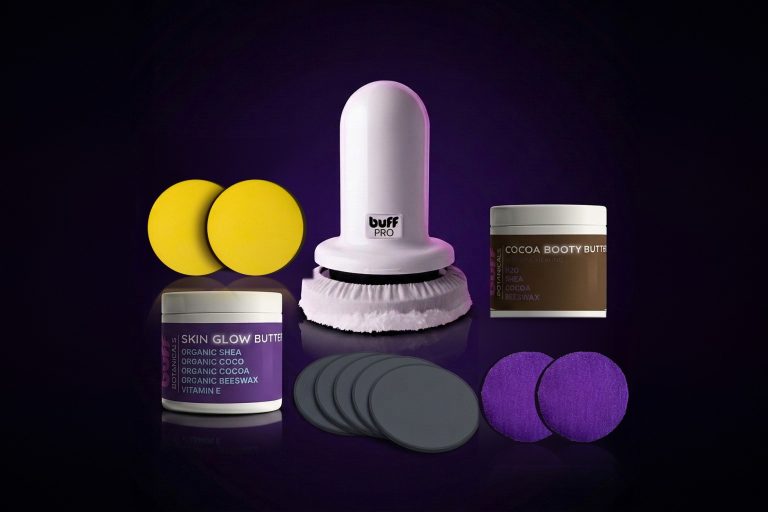
The BUFF PRO is a handheld device that does the motion for you. Its random-orbital head moves a BUFF Smooth Exfoliator pad over your skin in fast, overlapping circles. You guide it; it supplies the movement, so the pressure stays consistent from ankle to shoulder.
- Even motion. The same motion on your left leg as on your right, which is the main thing hand methods struggle with.
- Less effort. Short, gliding passes cover a whole leg quickly, without scrubbing.
- Easier on delicate spots. You can ease off on shins, inner arms and the chest without changing tools.
- More than exfoliation. Swap the pad for a Violet Lotion Mitt and the same device spreads lotion or body butter smoothly afterward.
The same cautions apply to any exfoliation, including BUFF: skip broken, sunburned or irritated skin, and moisturize after.
Which one is right for you?
Dry brushing makes sense if you want a low-cost daily ritual and light exfoliation, and you enjoy the few minutes it takes. Done gently and on a schedule, it keeps skin feeling soft.
BUFF makes sense if you have tried hand methods and find the results patchy, if your back and the backs of your legs never get done properly, or if you want exfoliation and moisturizing in one routine. Some people keep both: a quick brush on busy mornings and a full BUFF & GLOW session every two weeks or once a month, as the BUFF at Home page suggests.
Then the good part
Whichever you choose, the step after exfoliating matters as much as the exfoliating itself. Moisturizer spreads easily over freshly smoothed skin, and a rich body butter such as Skin Glow Butter leaves it feeling soft.
Brush, BUFF or both, the best routine is the one you actually look forward to. If you want to try the BUFF way, the home kit puts BUFF PRO, BUFFSMOOTH exfoliators, lotion mitts and body butters in one box. Go BUFF yourself.